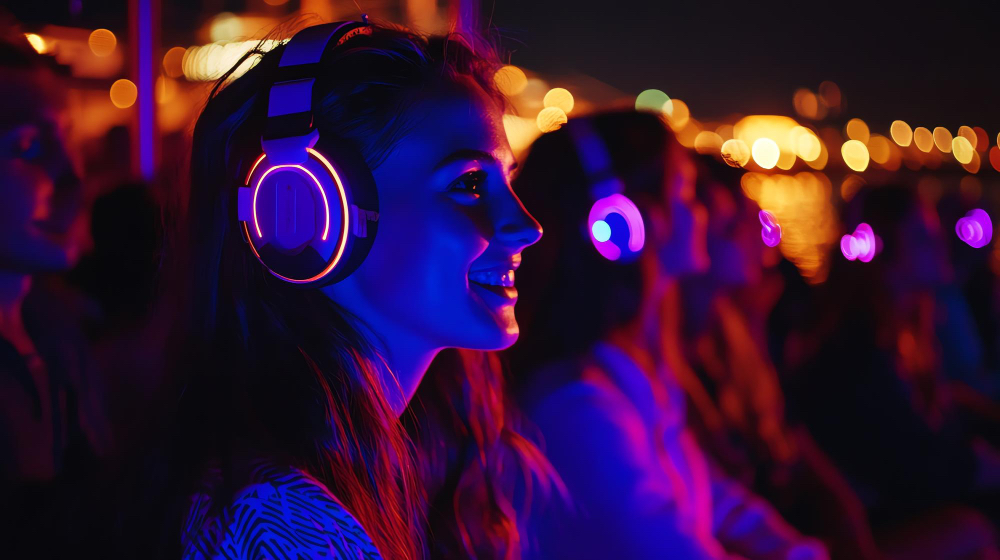
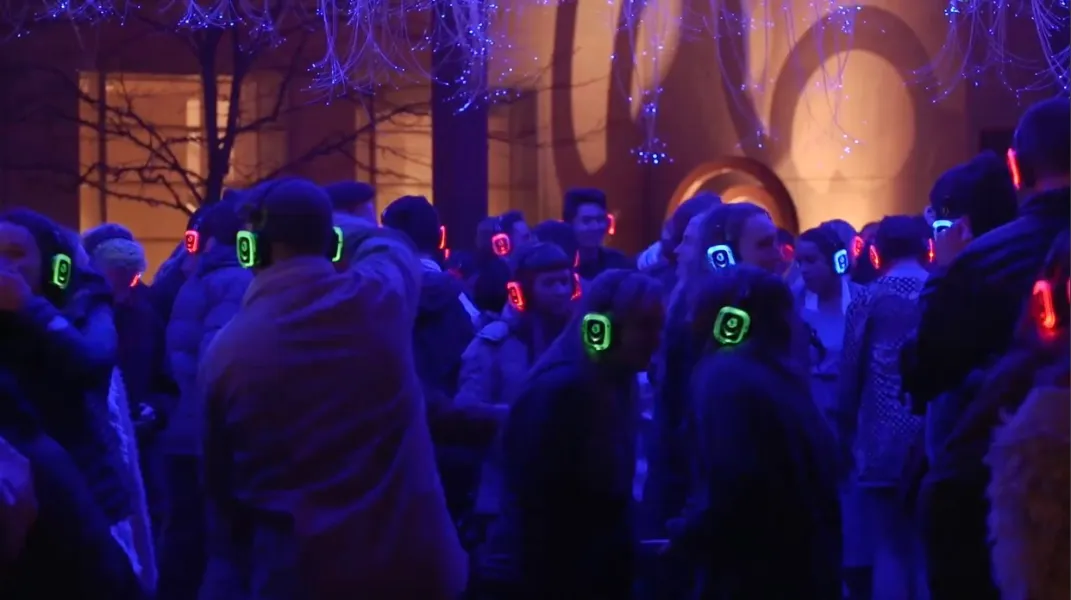
From the outside, the atmosphere can seem surprisingly quiet: people are dancing, singing, applauding… yet the room remains almost silent. In reality, everyone is immersed in the music at a comfortable volume, with no noise disturbance for neighbors, no speaker saturation, and an experience often more immersive than a traditional party.
If you’re wondering how a silent disco works, the answer is both simple and clever: public sound systems (speakers) are replaced by private sound delivery (headphones). This approach changes everything, especially for noise-sensitive venues, outdoor events, multi-ambience parties, and even unexpected uses such as sports, guided tours, conferences, and team-building activities. And because it’s highly flexible, it can adapt just as easily to a small party of 20 people as to a large event with hundreds of participants.
In this article, we’ll break down the technical operation in a clear way (without unnecessary jargon), discuss audio channels, range, battery life, and look at real-world use cases to understand why silent disco has become such a popular event solution.
To discover our solutions and prepare your event: Home · Equipment · Contact / quote
The principle: replacing speakers with wireless headphones
At a traditional party, a DJ sends music to a mixer, then to an amplifier and speakers that broadcast sound throughout the room. In a silent disco, you still have the DJ (or audio source), but instead of feeding speakers, the sound is sent to one or more transmitters that broadcast it wirelessly. Participants wear receiver headphones that pick up the signal and deliver the music directly to their ears. The result: the venue stays quiet while maintaining the energy of a real party.
This system offers several immediate advantages. First, each participant controls their own volume, reducing listening fatigue and making the experience more comfortable, especially during long events. Second, neighborhood constraints are greatly reduced: outdoors or in residential areas, you avoid complaints and decibel limits that can cut a party short. Finally, sound quality is often perceived as better because you avoid typical room issues such as reverberation, echoes, and uneven sound zones.
The technical operation, explained simply
To understand how a silent disco works technically, imagine a short-range radio system designed for music. You have: (1) an audio source (DJ, smartphone, computer, microphone, console), (2) a transmitter that takes the sound and sends it wirelessly, and (3) headphones that receive the signal. Each headset is an autonomous receiver: it doesn’t need a phone, Wi-Fi, or mobile data. It simply picks up the transmitter signal and converts it into sound.
In practice, the transmitter is usually connected to a mixer output (like a speaker) or directly to an audio source via a suitable cable. Once powered on, it “covers” a broadcast area. The headphones then sync to a channel (we’ll discuss this next). This setup makes installation quick: no need to run audio cables across the venue, position speakers, or manage monitor systems. Everything happens at the source and transmitter level, while the headphones handle the rest.
What matters most is system stability: it’s designed to provide simple, reliable broadcast suitable for events. Depending on the equipment, there may be adjustable settings (transmission power, channel selection, multiple transmitter management, etc.), but the principle remains the same: one audio source, one transmitter, many headphones.
Audio channels: the “superpower” of silent disco
One of the most famous features of a silent disco is the use of multiple audio channels. Instead of a single soundtrack for everyone, you can offer several atmospheres simultaneously, typically 2 or 3 channels (sometimes more depending on the system). Each channel corresponds to a transmitter (or output) and a distinct audio stream—for example, Channel 1 = electronic, Channel 2 = 80s hits, Channel 3 = hip-hop. Participants simply choose what they want to listen to on their headphones.
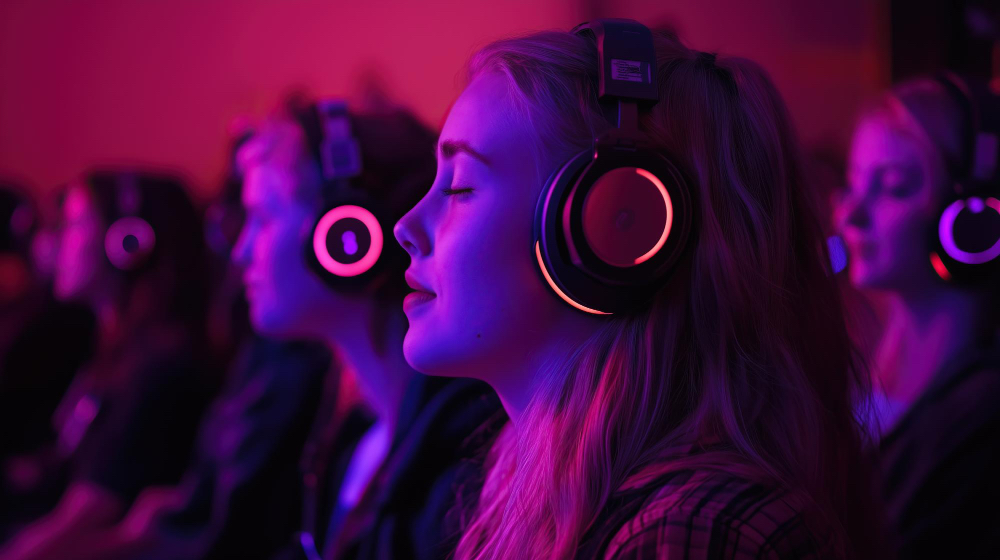
Visually, headphones often include colored LED lights (red, blue, green, etc.) indicating the selected channel. This is where the fun begins: you see groups forming based on colors, people switching channels, and even interactive games (“everyone switch to blue!”, “red vs green battle!”, etc.). Multi-channel setups are especially useful with diverse audiences, allowing each participant to choose instead of forcing a compromise playlist.
Technically, multi-channel works like several parallel broadcasts. Each headset can lock onto a specific channel, similar to tuning into a radio station. Users press a button to switch channels, and the headset instantly connects to the corresponding transmitter. It’s simple, intuitive, and allows multiple DJs, DJs plus playlists, or even a dedicated microphone channel.
Range: how far can headphones receive the signal?
Range depends on several factors: transmitter power, environment (walls, partitions, metal structures), venue layout, and crowd density. Typically, the goal is to comfortably cover the area where participants are located: dance floor, terrace, main room, or activity zone. In open spaces, range can be excellent, while complex buildings may create sensitive zones.
This is crucial for a smooth event: proper transmitter placement prevents dropouts and ensures a stable experience. In practice, transmitters are often positioned high with clear line-of-sight to the coverage area. For larger or more complex venues, adapted setups may be needed. The goal is not maximum distance, but stable reception where the event actually takes place.
If your event includes multiple zones (indoor + outdoor, multiple rooms, long spaces), planning coverage in advance is essential to avoid dead spots and ensure seamless listening.
Battery life: how long do headphones last?
Battery life is key, especially for long events. Silent disco headphones are battery-powered, and runtime depends on model, battery condition, average volume, and LED use. In most cases, they are designed to last a full event when properly charged.
Professional setups manage autonomy before the event: fully charged headsets, quick checks, and extra units as backup. For very long events (full-day conferences, multi-session schedules), rotation or charging stations may be planned. Even then, logistics remain lighter than traditional sound systems.
Real-world uses: where silent disco is most useful
1) Private parties and festive events
This is the most common use: birthdays, weddings, corporate parties, festivals, pop-up bars, rooftops. Silent disco is ideal where noise is restricted. Multi-channel setups satisfy multiple generations, and the silent atmosphere creates a memorable “wow” effect.
2) Sports and group activities
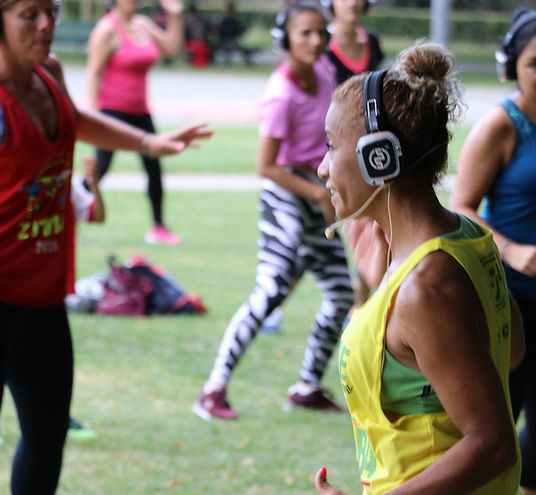
Silent disco is increasingly used for fitness classes, yoga, dance sessions, or outdoor training. Coaches speak into microphones while music and instructions are delivered clearly through headphones, even in noisy environments.
3) Conferences, trade shows, and guided tours
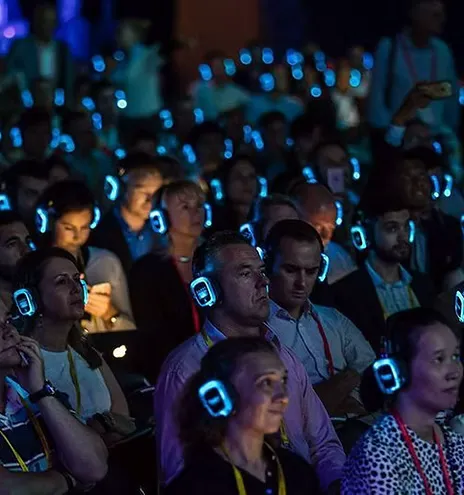
At conferences or exhibitions, ambient noise can be a major issue. Headphones allow clear communication, multilingual setups, and guided tours without raising voices. They improve professionalism and comfort.
What do you need to organize a silent disco?
At minimum: headphones (one per participant), one or more transmitters, and an audio source. The exact setup depends on your event format and space.
To explore available options: Discover silent headphone activities
FAQ: quick answers
Is a silent disco really silent?
For participants, no—they hear music through headphones. For outsiders, yes—there are no loud speakers.
Is installation complicated?
Usually much simpler than traditional sound systems.
How many channels should you choose?
One is enough for simple events; two or three are ideal for multi-ambience setups.
What happens if someone leaves the coverage area?
The sound may fade or cut off if they move too far away.
Conclusion: why silent disco is so popular
Silent disco isn’t just a novelty—it’s a practical solution that solves noise constraints while enhancing immersion and flexibility.
Next step: Contact / quote
Back: Home